

The temperature regimes within flowers and inflorescences, though not extensively studied, play a significant role in plant sexual reproduction, particularly in the process of pollination.
This study reports on how ambient air temperatures and insolation—categorized as sunny, cloudy, or nighttime—affect the temperatures within the varying sizes of the complex flowering head of teasel (Dipsacus fullonum). These blossom temperatures influence pollination in various ways, notably by affecting the growth and maturation of the sexual organs and influencing pollinator behavior. The findings indicate that the inflorescences of common teasel warm up beyond the surrounding ambient air temperatures by absorbing solar radiation and trapping heat. The factors of inflorescence size, time of day, and insolation significantly impact the temperatures within teasel inflorescences. Researchers observed that large inflorescences, approximately 50 mm long and 30 mm in diameter, can become as much as 8°C warmer than the ambient air during the time of day when the sun is at its peak (approximately 10:00–14:00 EST). Medium-sized inflorescences, around 30 mm long and 20 mm in diameter, exhibit temperatures about 5°C higher, while small ones, roughly 20 mm long and 10 mm in diameter, are around 3°C warmer. These temperature excesses, noticeable under sunny conditions, are eliminated at night and on cloudy days. Pollinator activity, primarily carried out by bumblebees (Bombus) on teasel heads, aligns with these temperature trends, being most vigorous under warm, sunny conditions.
This correlation might reflect the underlying relationships between floral biology and pollinator behavior, such as the impact of floral heat on nectar secretion, viscosity, availability, pollen presentation, and the maturation of florets.
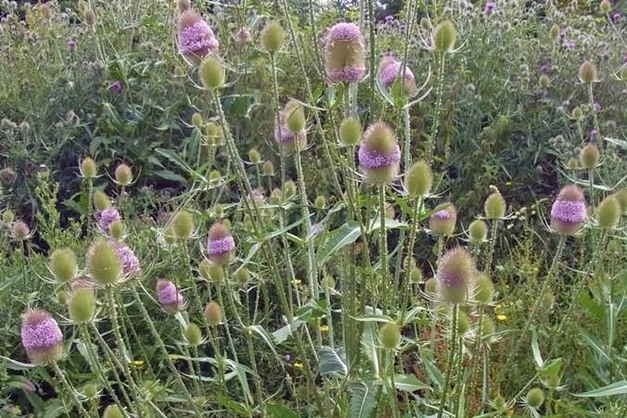 © Peter G. KevanFlowering heads of teasels (Dipsacus fullolum) showing the whorls of florets and the differing sizes of the heads. The paired leaves on the flowering stems form cups at their bases which catch rainwater and have been proposed (by Charles Darwin) to prevent herbivores from climbing the stems and damaging the heads.
Shavit, O., & Kevan, P. G. (Corresponding Author). *The Secret of Hot-headed Teasel (Dipsacus fullonum L. (Caprifoliaceae)).* Beit Alfa, 1080200, Israel, and School of Environmental Sciences, University of Guelph, Ontario N1G 2W1, Canada. Corresponding author email: [email protected]. ORCID iD: Kevan: 0000-0001-8919-8399.