

Current efforts to reduce peat use in horticulture raise the question of how alternative materials perform in demanding foliage crops. A recent R&D trial in Klasmann-Deilmann's Geeste greenhouse examined the effect of its new TerraCoal biochar in substrates for Dieffenbachia 'Camilla' and Calathea rufibarba, focusing on plant quality, pH behaviour and general cultivation performance.
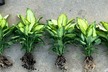
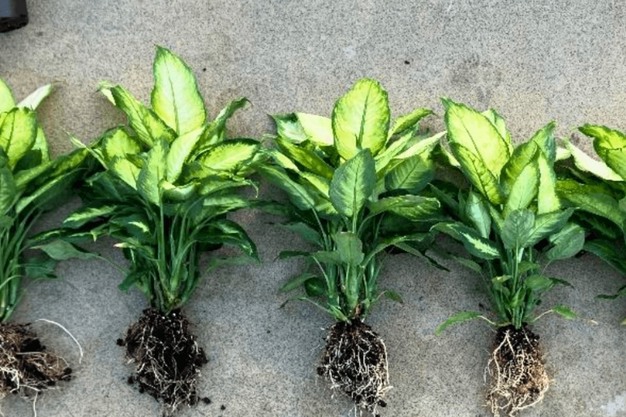
Both crops showed stable development in substrates containing 10% biochar. Dieffenbachia formed uniform root systems and maintained consistent growth throughout the trial. Calathea, a crop sensitive to fluctuations in substrate conditions, produced good leaf substance and leaf colour in the same treatment. These observations indicate that moderate biochar inclusion can support and stabilise reliable growth in peat-reduced and peat-free mixes.
The trial also showed that mixes containing TerraCoal maintained more stable pH values, particularly in the peat-free formulations. This is relevant for Calathea, which can react quickly to pH shifts. More predictable pH behaviour may help reduce cultivation challenges for the grower related to nutrient uptake.
 © Klasmann-Deilmann Group
Replacing part of the peat in the substrate recipe with alternative constituents and incorporating biochar reduced the calculated CO₂ emissions per cubic metre of substrate. This reflects both the lower peat content and the carbon retention characteristics of the biochar used. Emissions from the substrate as a whole can be largely or even fully offset by TerraCoal, depending on the amount used in the substrate.
The peat-free mixes without TerraCoal in these trials required closer attention to irrigation and nutrient supply and showed weaker plant development. This underlines that adjustments in water and fertiliser management during cultivation generally are important when moving towards peat-free production systems. However, adding TerraCoal biochar to the peat-free growing medium can also help the grower manage the crop.
For Dieffenbachia and Calathea, the use of 10% TerraCoal supported stable plant growth and improved pH behaviour while contributing to a lower substrate-related carbon footprint. These results indicate that biochar can be a useful component when developing peat-reduced and peat-free substrate concepts in future, provided that cultivation parameters on the nursery are adapted accordingly.
For more information:
Klasmann-Deilmann GmbH
[email protected]
www.klasmann-deilmann.com