


Two complementary studies provide new insight into how a Bacillus velezensis–based biostimulant interacts with nutrient management to influence the growth and performance of French marigolds. The findings highlight the importance of aligning biostimulant use with appropriate phosphorus and overall fertilizer levels to achieve consistent plant growth benefits.
French marigold (Tagetes patula) is a widely produced ornamental valued for its vibrant color and adaptability in landscapes and containers. As growers seek sustainable strategies to improve nutrient use efficiency and reduce input costs, microbial biostimulants have emerged as promising tools. The new research evaluates how one such product performs under varying nutrient conditions.
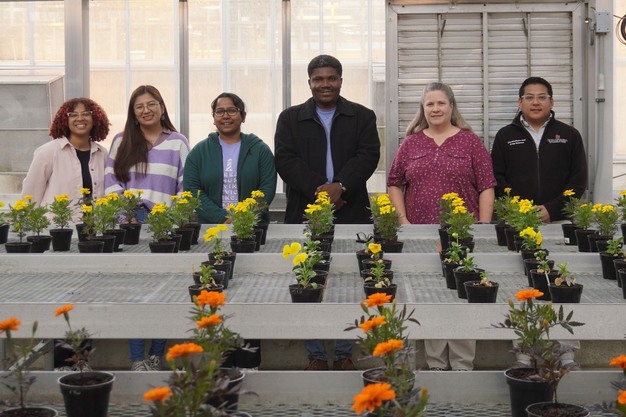 © Juan Quijia-PillajoGraduate students with their research projects in the Research Greenhouses on the CFAES OSU Wooster Campus. Graduate students are (from left to right) Ashly Ramos, Alexandra Espinoza, Janhavi Maurya, and Israel Acham. Also pictured is Dr. Michelle Jones and Dr. Juan Quijia-Pillajo (course teaching assistant)
Biostimulant performance across phosphorus levels
The study, "Influence of a Bacillus velezensis–Based Biostimulant on French Marigold Growth Under Different Phosphorus Levels," examined plant growth responses across a range of phosphorus concentrations. The lead author on this study, Alexandra Espinoza, is a PhD candidate at The Ohio State University Department of Horticulture and Crop Science.
Results indicate that plant performance was closely tied to nutrient availability. Under certain phosphorus conditions, plants treated with the biostimulant showed enhanced growth metrics compared to untreated controls, including improved biomass accumulation and overall vigor. However, the magnitude of response depended on phosphorus supply, demonstrating that microbial biostimulants do not operate independently of fertility programs.
The findings suggest that optimizing phosphorus management is essential to fully realize the potential of microbial-based products in ornamental production systems.
Fertilizer rate influences growth response
A companion study, "Plant Growth Promotion in Lalrise Vita Treated French Marigolds Is Influenced by Fertilizer Rate," further explored how fertilizer levels affect plant response to the same biostimulant formulation. The lead author on this study was Ashly Espinoza, also a PhD student at OSU.
Researchers evaluated marigold growth across multiple fertilizer regimes and found that plant growth promotion was significantly influenced by nutrient rate. In some fertility scenarios, treated plants exhibited measurable improvements in shoot growth and plant quality. In others, the difference between treated and untreated plants narrowed, reinforcing the concept that biostimulant efficacy is context-dependent.
The results demonstrate that fertilizer rate can either amplify or limit observable benefits, underscoring the need for integrated nutrient and biostimulant management strategies.
Toward integrated nutrient management
Together, the two studies provide a clearer framework for growers considering microbial biostimulants in ornamental production. Rather than serving as a replacement for fertilizer, Bacillus velezensis–based products appear to function as complementary tools whose effectiveness depends on the surrounding nutrient environment.
By identifying how phosphorus levels and overall fertilizer rates interact with biostimulant application, the research offers practical guidance for refining production protocols. Strategic alignment of fertility programs with microbial inputs may improve nutrient efficiency, support consistent crop quality, and enhance sustainability in greenhouse and nursery systems.
As interest in biologically based production inputs continues to grow, these findings contribute valuable data to help producers make informed decisions and maximize returns from integrated crop management practices.
The research described in these articles was carried out by graduate students in the Wooster lab section of a floriculture crop production course. Students took full ownership of their projects—developing research questions, designing experiments, and conducting the work themselves. All projects were centered on the use of biostimulants in floriculture. Working with a product previously tested in the lab, students focused on understanding how its effectiveness is influenced by different fertilizer practices. The goal was to generate practical, evidence-based recommendations for growers interested in integrating biostimulants into their nutrient management programs.
After the conclusion of the course, several students pursued publication of their findings. The short, open-access article format provided an accessible way to share results with a broad audience and served as a valuable opportunity for first-time peer-reviewed publication. Building on this experience, instructors plan to incorporate manuscript preparation as a formal component of future courses to further support student research and professional development.
The full article can be read on the ASHS HortTech electronic Journal website at the links here and here.